Skylights in Midlothian, TX
Skylights in Midlothian, TX come in three very different jobs, and a stain in the shaft corner does not tell you which one you have. One of our roofers gets up next to yours before anybody quotes a number.
Water travels around a skylight rather than being sealed out of it.
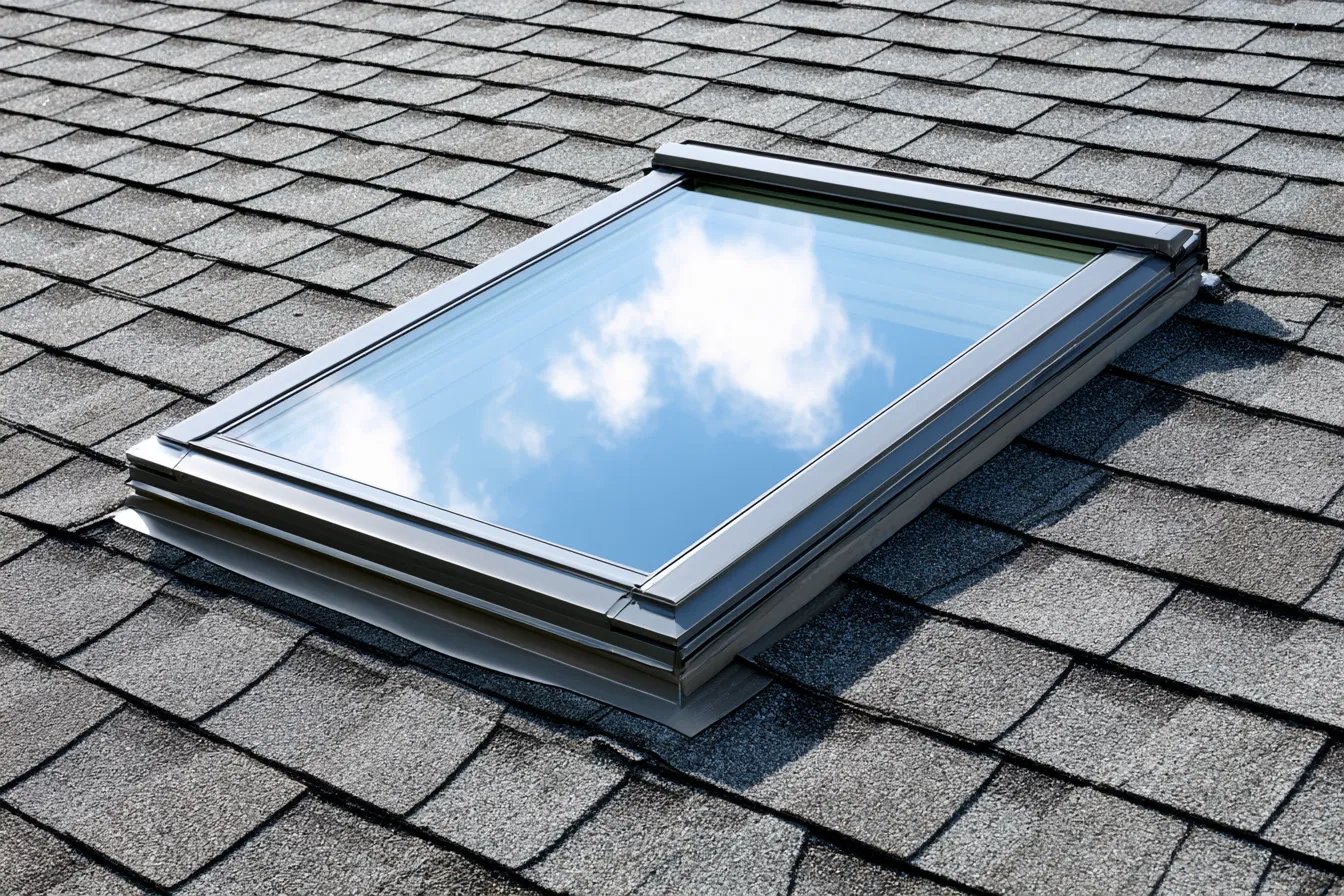
Skylights in Midlothian, TX sit on a curb, which is a low frame built up off the roof deck so the glass stands above the plane of the shingles. A roofer wraps that curb in metal: a piece across the bottom woven into the shingle courses, angled pieces stepping up both sides, and a cap across the top.
None of that metal is sealed shut. It is shaped to send water around the opening and back onto the roof below, the way a stone in a stream parts the current instead of stopping it. So when a skylight leaks, the pane and its gasket are usually fine, and what gave out is a piece of that metal, or a bead of caulk somebody once used instead of one.
What skylight work in Midlothian covers.
Three jobs and three price tags live under one word. Reflashing, swapping the unit and cutting a new opening are separate pieces of work, and only one of them touches the glass.
- 01Reflashing what is there
- Old metal off, new metal woven into the shingle courses. The courses have to come up on both sides to do it, which is why it is roofing work start to finish.
- 02Replacing the unit
- Swapped while the surrounding roof is already open, which is the cheap moment. The flashing has to be rebuilt either way, so the unit itself is the only extra line.
- 03Cutting in a new one
- A new opening framed and curbed, carpentry as much as roofing. Rafters get cut and headed off, and the curb is built up so the glass stands clear of the shingle plane.
- 04The curb underneath
- Rot in the frame gets rebuilt first; new metal on bad wood fails. A curb takes water on all four sides, so it goes soft years before anything else around the opening does.
- 05Decking around the opening
- Checked from the roof and from the attic, since sheathing soaks quietly. A stain on the underside of the deck shows how far the water traveled before it found the shaft.
- 06Closing one off
- Deck, underlayment, and shingles carried across when it is not worth keeping. The plane ends up continuous, and closing the shaft below belongs to drywall.
Which of the three you are looking at is normally clear within a few minutes of somebody being up there. A free inspection settles it before you commit to anything.
How a Midlothian skylight job runs.
Nothing gets opened up here until the entry point is actually known. The first move is the whole reason the repair holds.
Find the entry point
A stain in a skylight shaft can come from the flashing, from the roof plane uphill of it, or from moisture condensing on cold glass. That gets settled first, from up top and from inside the attic, because the three have nothing in common but the stain.
Open the courses
Shingles come up around the opening so the metal and the curb are in plain view. The roofer photographs whatever the wood looks like under there before a single thing goes back down.
Rebuild it in order
New metal weaves in with the shingle courses, tucked under the ones above it, and the roof closes back around it. You get the reason the old one leaked written down next to the work.
Signs a Midlothian skylight is due for work.
Two of these get called leaks every week and are not leaks. Condensation and a failed glass seal both arrive as water on the inside, and neither one starts on the roof.
- Stain in a shaft corner: wind-driven rain got under a piece of flashing, almost never through the glass. Corners are where the four runs of metal meet, which makes them the first place to give.
- Beads on the glass at dawn: that is condensation, an air and moisture question. It clears by afternoon and returns on the next cold morning, which no leak does.
- A pane gone cloudy or fogged: the seal inside the insulated glass has failed, and the whole unit comes out. The haze sits between the two panes, so cleaning either face changes nothing.
- Caulk visible from the roof: somebody sealed over a detail that needed rebuilding. Sealant on a curb has a couple of years in it at most, and the water kept moving underneath the whole time.
- A skylight older than the roof: its flashing is a generation behind the shingles it has to work with. Old and new metal rarely lap cleanly, and the seam between them is where the next leak turns up.
- Damp shaft or daylight in the attic: worth catching now, while the ceiling still looks fine. Water reaches the drywall last, so the attic gives you a season of warning.
A skylight that has been quietly wetting decking is a far smaller job caught early. Once the stain reaches a ceiling you are into a roof repair instead. Not sure which of the three you have? Call and describe what the ceiling is doing, and our roofers will tell you what to expect.
What a skylight reflash runs.
Rebuilding the metal around a skylight runs about what it runs around a chimney or down a valley. Nationally that work sits around $600 to $1,000 and up, depending on what the wood underneath turns out to be, and resealing flashing that is still sound is a much smaller job at about $150 to $250. Your roof gets its own number once somebody has been on it.
The unit itself does not get a range here, because size and type decide it more than the roof does.
Start a skylight estimate- Reflashing during a tear-off costs far less than doing it alone.
- Rot in the curb prices once it has been uncovered.
- A brand-new opening prices as framing plus roofing.
Where skylights show up on Midlothian houses.
The age of the roof narrows the list before anybody climbs anything. A skylight that came with the house behaves differently from one cut in twenty years later, and both differ from one on a five-year-old roof.
- 01The 2000s builds
- About a third of the houses in town went up that decade, and the typical Midlothian home dates to 2004. Flashing that age wants a look well before the glass does.
- 02The newest subdivisions
- Much of the city's newest housing was built between 2018 and 2024. A leak on a roof that young almost always traces to one detail of the original install.
- 03The oldest streets
- The oldest streets here go back to the 1880s, and skylights on those houses were usually added later. A retrofit opening is worth looking at closely.
- 04Hail on glass
- Ellis County has logged 17 hail days and 80 hail reports, the biggest hail well past golf-ball size. Hail like that cracks a pane outright, and a roofer documents it with the rest of the hail damage.
That is background, not a diagnosis. What your own skylight is doing only shows up once somebody is standing beside it.
Skylight questions.
Most skylight trouble starts as water that turns out not to be a leak. These are the questions that come up before anybody gets on the roof.
Q1It leaks in heavy rain but not light rain. Why?
Q2Is it condensation or a leak?
Q3Should the skylight be replaced when the roof is?
Q4Is the leak the skylight or the roof around it?
Q5Can a skylight just be removed and closed up?
Q6Will hail crack a skylight?
Start your Midlothian skylights estimate
Send a photo of the stain or the frame and say when it turns up, or call and describe it. A roofer gets up there, names which of the three jobs you have, and hands you the scope and the price on one page. The answer comes with no pressure attached.